Elsa's artistic success implies that the most important thing about portrait photography is an interest in your subject. If you are so busy working that you can't care about strangers, don't take their photos! Or at rate, don't expect those photos to be good. Some of my better portraits were taken on a trip to Alaska and back because I had 3.5 months in which to be alone and learn to appreciate the value of a stranger's company and conversation.


Location
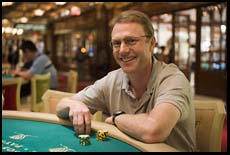
If you don't have or can't create a photo studio, concentrate on environmental portraiture. Show the subject and also his surroundings. These tend to work best if you can enlarge the final image to at least 11x14 inches. In any smaller photo, the subject's face is simply too small. Taking photos that will enlarge well is a whole art by itself. Your allies in this endeavor will be a low ISO setting, prime (rather than zoom) lenses, a tripod, and at least a mid-range digital SLR.
There are two elements to a photo studio for portrait photography. One is a controlled background. You want to focus attention on your subject and avoid distracting elements in the frame. Probably the best portraits aren't taken against a gray seamless paper roll. On the other hand, you are unlikely to screw up and leave something distracting in the frame if you confine yourself to using seamless paper or other monochromatic backgrounds. You don't have to build a special room to have a controlled background. There are all kinds of clever portable backdrops and backdrop supports that you can buy or build. If you absolutely cannot control the background, the standard way to cheat is to use a long fast lens, e.g., 300/2.8. Fast telephoto lenses have very little depth of field. Your subject's eyes and nose will be sharp. Everything else that might have been distracting

No comments:
Post a Comment